Take a look at infinity…
Take a look at infinity…

The Philharmonia Orchestra (London, UK) plays In the Bleak Midwinter.
Recall the homily of Pope Francis on November 19:
We are close to Christmas: there will be lights, there will be parties, bright trees, even Nativity scenes – all decked out – while the world continues to wage war. The world has not understood the way of peace.
…
What shall remain in the wake of this war, in the midst of which we are living now?
What shall remain? Ruins, thousands of children without education, so many innocent victims: and lots of money in the pockets of arms dealers. Jesus once said: ‘You can not serve two masters: either God or riches.’ War is the right choice for him, who would serve wealth: ‘Let us build weapons, so that the economy will right itself somewhat, and let us go forward in pursuit of our interests. There is an ugly word the Lord spoke: ‘Cursed!’ Because He said: ‘Blessed are the peacemakers!’ The men who work war, who make war, are cursed, they are criminals. A war can be justified – so to speak – with many, many reasons, but when all the world as it is today, at war – piecemeal though that war may be – a little here, a little there, and everywhere – there is no justification – and God weeps. Jesus weeps.
Peace, please?
Last verse:
What can I give Him,
Poor as I am?
If I were a shepherd
I would bring a lamb;
If I were a wise man
I would do my part;
Yet what I can, I give Him –
Give my heart.
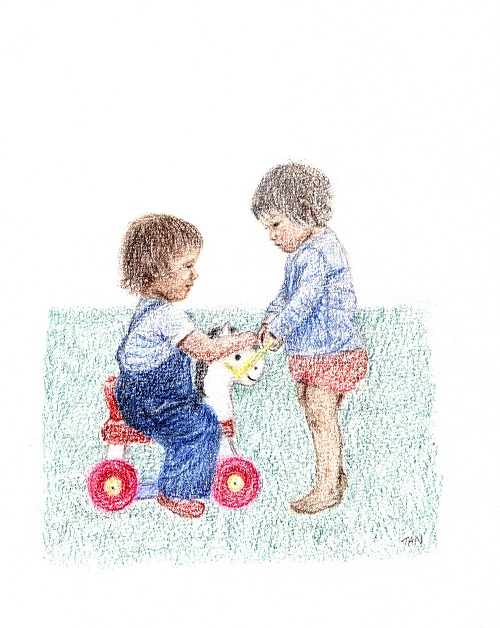
The Horse
Coloured pencil drawing. Available as 4″ x 6″ print mounted on greeting card.
The Fisher Price horse broke after one move too many. It was in the basement for many years, still ridable but at some risk, and I was surprisingly sad when I finally put it in the garbage can.
You will find this greeting card at Little Earth, 1020 Commercial Drive, Vancouver, B.C.

Du Fu “Night in a Pavilion”
Translation and artwork: Lena Tan, 2003
(712-770, Tang Dynasty)
Du Fu came from a family of distinguished scholars and officials. In his youth, he showed a talent for poetry and calligraphy. All his life he longed to serve his emperor and country but failed to secure a stable role in officialdom, which consigned his family to a life of relative poverty. He observed the extravagance of the emperor’s court, the suffering of the people, and the ravages of war, and wrote about that in his poetry.
Du Fu is an acknowledged virtuoso in technique and language, master of the perfect couplet while innovative in style and content. Another Tang poet, Yuan Zhen, inscribed on Du Fu’s tomb: “Since there have been poets, there has never been Du Fu’s equal.”
More poets…
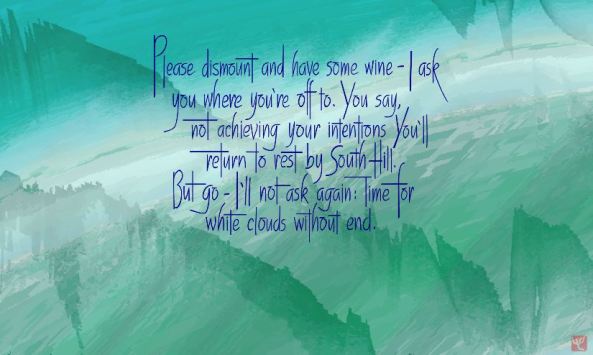
Wang Wei, “A Parting”
Translation and artwork: Lena Tan, 2003
(701-761, Tang Dynasty)
Born into an established family, Wang Wei enjoyed a position in high society, serving successfully in government. He was well-schooled in poetry, calligraphy, music and painting, and was sophisticated and innovative in his art. He became a devout Buddhist and wrote meditative poems of great simplicity and understatement. Yet his work reflected an ongoing discord between his sense of public responsibility and a private desire for renunciation.
More images…
More poets…

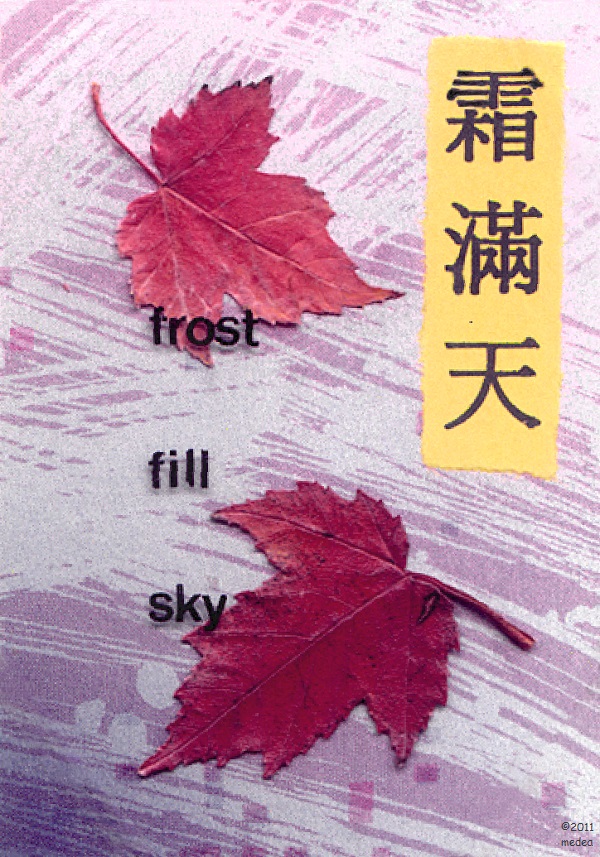
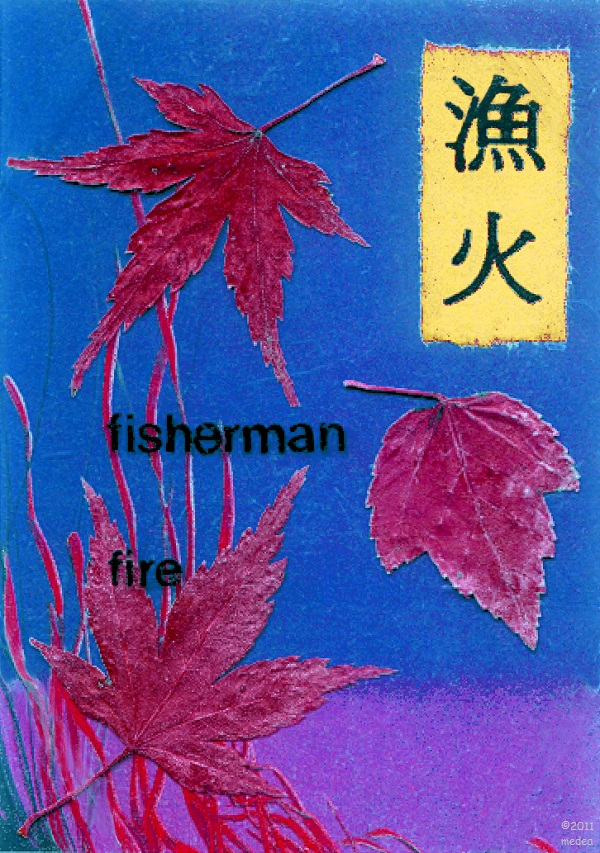

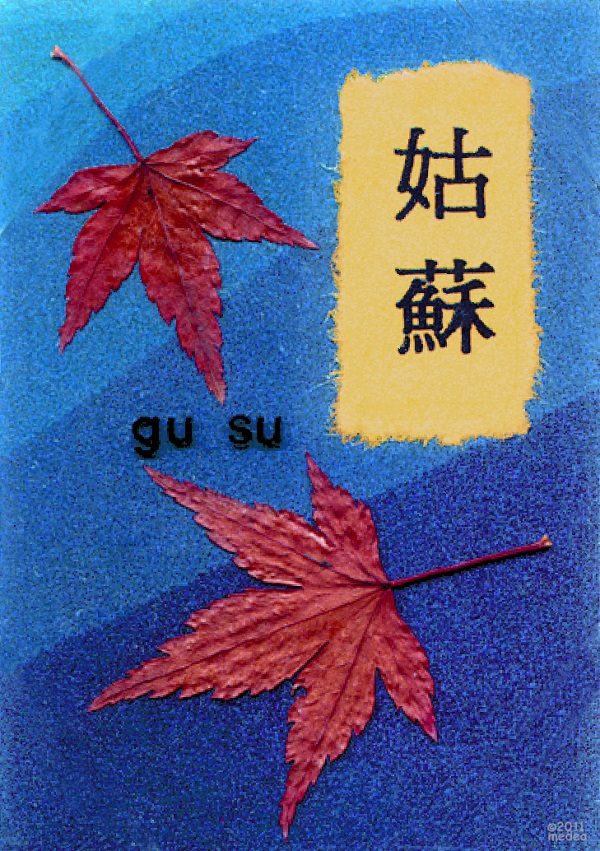
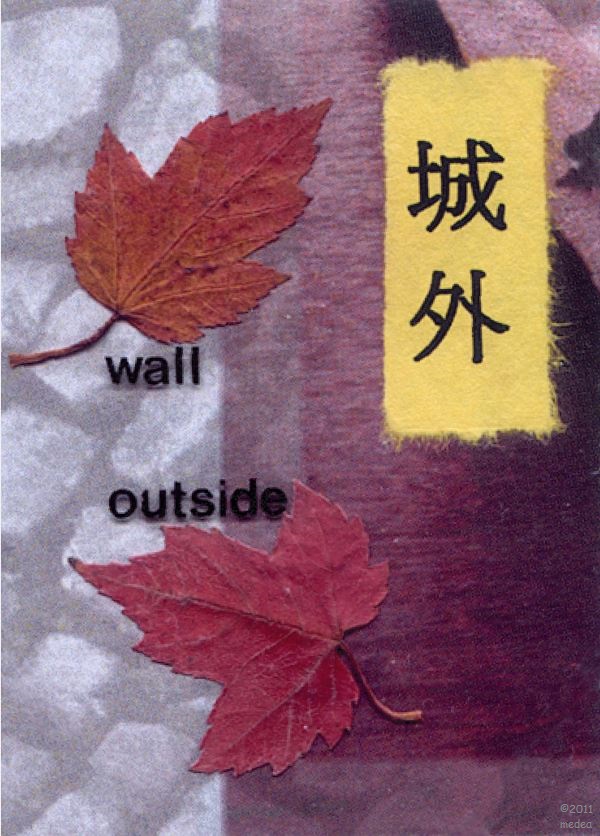


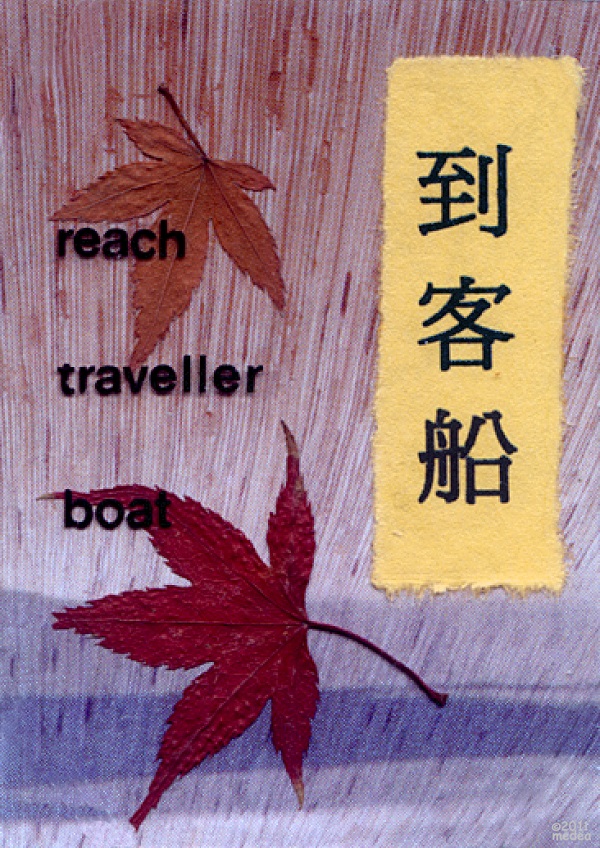
This poem by Zhang Ji (張繼 c.800, Tang Dynasty) is a seven-character quatrain, consisting of two pairs of parallel couplets. It has long been regarded as a masterpiece in that genre.
Gusu, now part of the modern city of Suzhou, was the capital of the ancient state of Wu in southern China.
Around 500 BCE, the states of Wu and Yue contended for supremacy. According to the legend, the King of Yue presented the King of Wu with the beautiful Xi Shi. The King of Wu was so beguiled with her that he was unprepared when the King of Yue attacked and defeated him. Part of the melancholy of the poem is the evocation of the well-known legend in the name of the old city.
The first Cold Mountain (Hanshan) Temple was built in the Liang Dynasty (502-557).
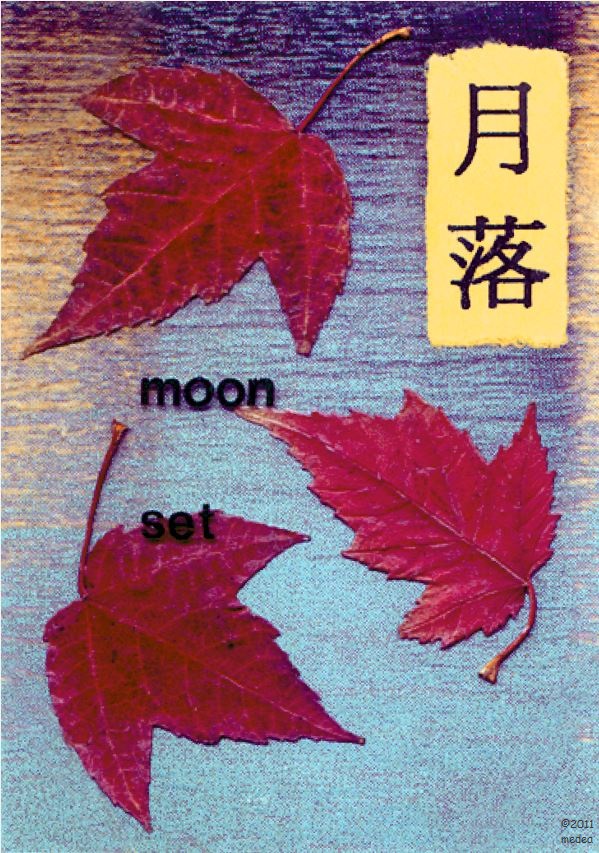
These ATCs have been traded but are available as 4″ x 6″ prints.

Chang-E in her moon palace; mid-autumn festival 2003
Mid-autumn festival, sipping osmanthus tea and nibbling on lotus mooncake.
The Song poet Li Qingzhao 李清照 (c.1083-aft.1149) posed a riddle:
Naturally, it ranks first among flowers.
The plum surely is jealous,
The chrysanthemum should be ashamed;
It opens by the painted railing, capping the mid-autumn.自是花中第一流.
梅定妒,
菊應羞,
畫欄開處冠中秋.
(from “Partridge Sky” 鷓鴣天, 暗淡輕黃體性柔)
Another Song poet Su Shi 蘇軾 (1037-1101) raised his wine cup, and, thinking of his brother far away, sang to the full moon:
We can only hope to live long,
And across a thousand li, together cling to its beauty.但願人長久
千里共嬋娟
(from “Prelude to the Water Melody” 水調歌頭, 明月幾時有, written in 1076 )
Translations by Lena Tan
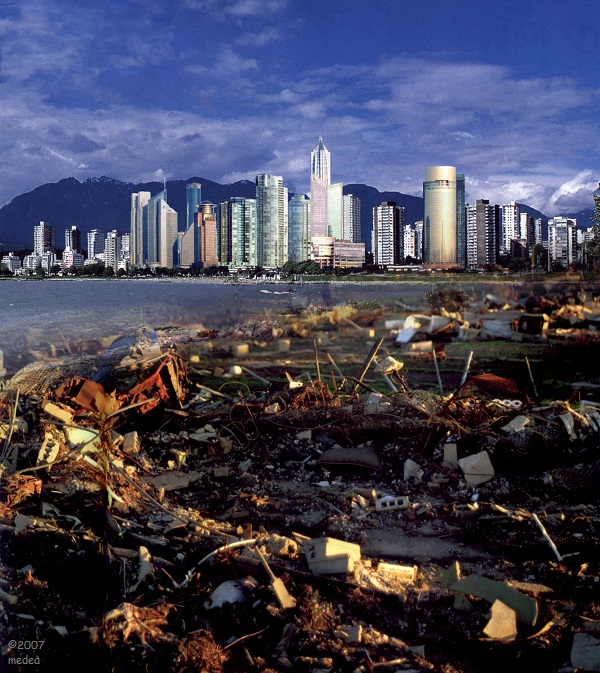
After the Tsunami
My apocalyptic vision from 2007. Oddly, parts of Shanghai appear to have washed up on English Bay.

This set of prints, entitled “Critical Collages,” are composed from a random collection of printed ephemera, digitally retouched and enlarged. The images, as much the result of chance as of deliberation, hint at oblique commentaries on culture and society. Originally ATCs, they are available as 6″ x 4″ or 10″ x 8″ prints.
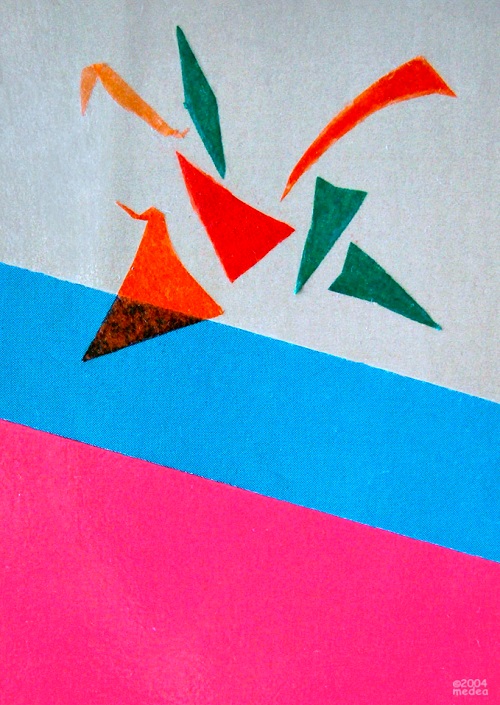
 Found Images